 Ahmed Saad
My Obsidian vault is my Hermes Agent's second brain
One Obsidian vault holds my agents' mission, scans and rules. A map file that says what lives where is what makes it work.
- Issue
- #3
- Published
- Reading time
- 5 min
- Stack
- Hermes Agent, Obsidian, GitHub, Nuxt, Supabase
The problem
Hermes Agent has memory, but it's small and it's the agent's own. Each session starts with a page or two about me and my preferences, and that's all it knows. Everything else, the mission, the market scans, the research, the rules of how we work together, would live and die inside separate chats.
I didn't want a second brain for myself. I already had notes. I wanted one my agents could use.
What I built
One Obsidian vault in OneDrive, and a map that says what lives where. The agents read the map before they touch anything.
The layers:
- The hub (00 - Mission.md). The goal, the current phase, the weekly quotas, the decision log. Every session that touches the mission reads this file first and updates it last. It's how two sessions on different days continue the same work.
- How We Work.md. The operating system. Four layers: Goal, Knowledge, Doing, Watchers. Which cron runs on which schedule, which folder belongs to which job, and the ownership rules. When the way we work changes, this file changes the same day.
- Knowledge (Research/). Deep research, one document per topic. My freelance plan, a fact-check of the "personal software" trend, agent loops. A new version replaces old, the old one gets deleted, the change is logged.
- Doing (Mission/Weekly/). A week file with dated tasks, and a journal where the numbers land. A cron creates the next week's files every Sunday, so the structure exists before Monday does.
- Watchers (Freelance Job Demand Scan/, Grok X 24h Trends/). Crons write here on their own schedules. The job scan runs every 30 minutes and archives postings. A daily pull brings Grok's trending X reports from a GitHub repo into the vault, a file per day. Nobody reads these files daily. They're the archive the agents mine.
- The map rule. Nothing crosses folders without a documented reason in How We Work. When I catch a file in the wrong place, the map gets the correction, not just the file.
Two agents share this vault. The first agent reads the brand facts and drafts website content. The second runs the mission, the scans and the crons. They leave each other notes through the files themselves, and anything one agent finds that could become a Lab entry goes to a shared observation log in a private GitHub repo.
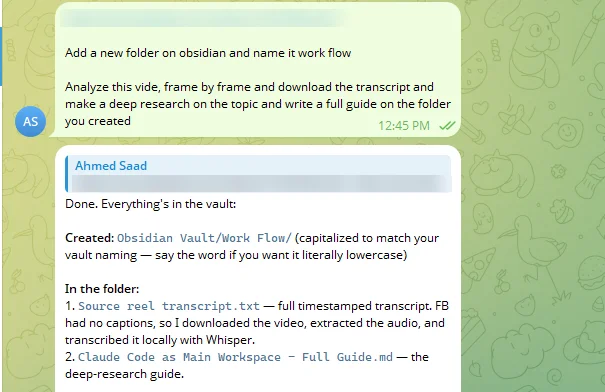
Telegram is the front door. I message the agents from my phone: a link to a reel, a question, a task. One recent example: a reel about using Claude Code as a main workspace. I sent the link and asked for a new folder, the transcript and a full guide. The agent downloaded the video, transcribed it locally with Whisper, went through it frame by frame, checked the claims, and saved the verified notes into the new Work Flow folder. The reel arrived in a chat and left as structured notes I can search.
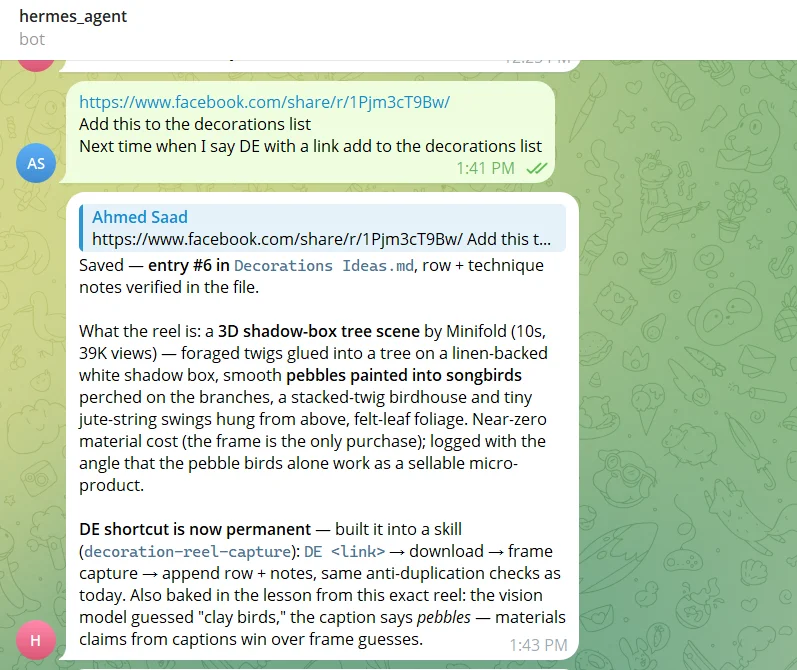
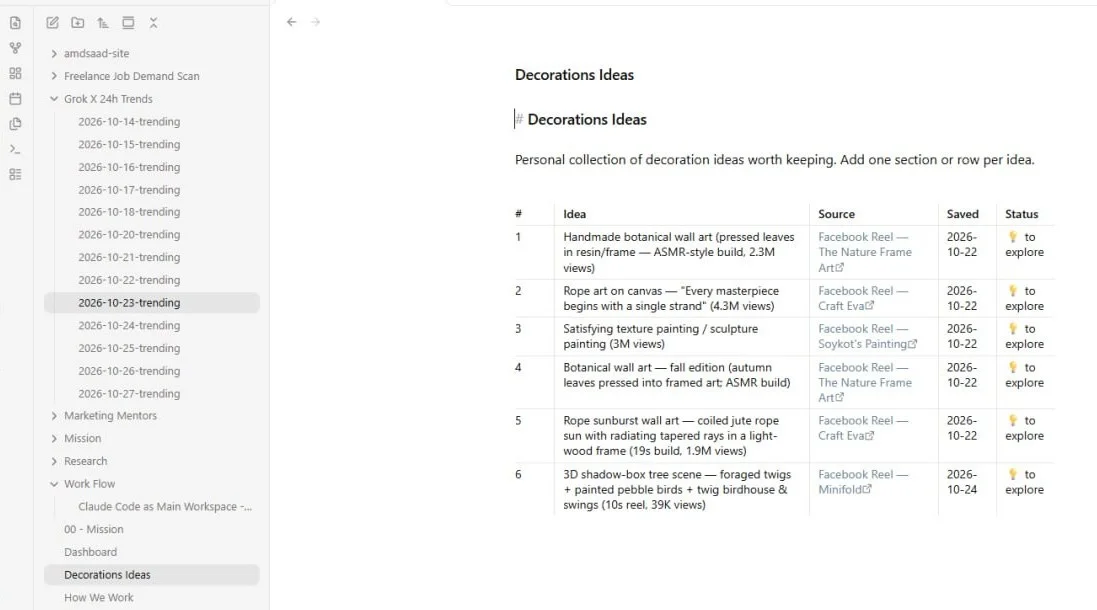
The vault isn't only for the agents. I use Obsidian the normal way too, for personal notes and ideas. When I send something worth keeping, like a decoration idea from a reel, the agent adds it as a row in the Decorations Ideas note, next to my own notes. I also told it to treat "DE" plus a link as a shortcut for this. It built that into a skill and recorded a lesson from this reel: the vision model guessed "clay birds", the caption said pebbles, so captions now win over frame guesses. One vault, two writers: me in Obsidian, the agents through Hermes.
What I learned
- The map is the memory. The files matter less than the document that says what they're for. Without How We Work, every session reinvents its own idea of the vault and the folders drift.
- Memory outside the agent beats memory inside it. The built-in memory is a paragraph. The vault is unlimited, versioned, and I can read and correct it in Obsidian whenever I want. When an agent gets something wrong about how we work, I fix the file, not the agent.
- Naming discipline is part of the design. A draft once said "the vault" and "the bot". A reader has no idea what those are. In public copy, and in the map itself, things get their real names: the Obsidian vault, Hermes Agent. If a term needs context the reader doesn't have, the first sentence provides it.
Links
- Hermes Agent: https://github.com/NousResearch/hermes-agent
- How I ship with Claude Code: https://amdsaad.com/lab/ship-with-claude-code
Links
Want an AI assistant that works from your team's shared notes instead of a chat history? Tell me what you're working with.